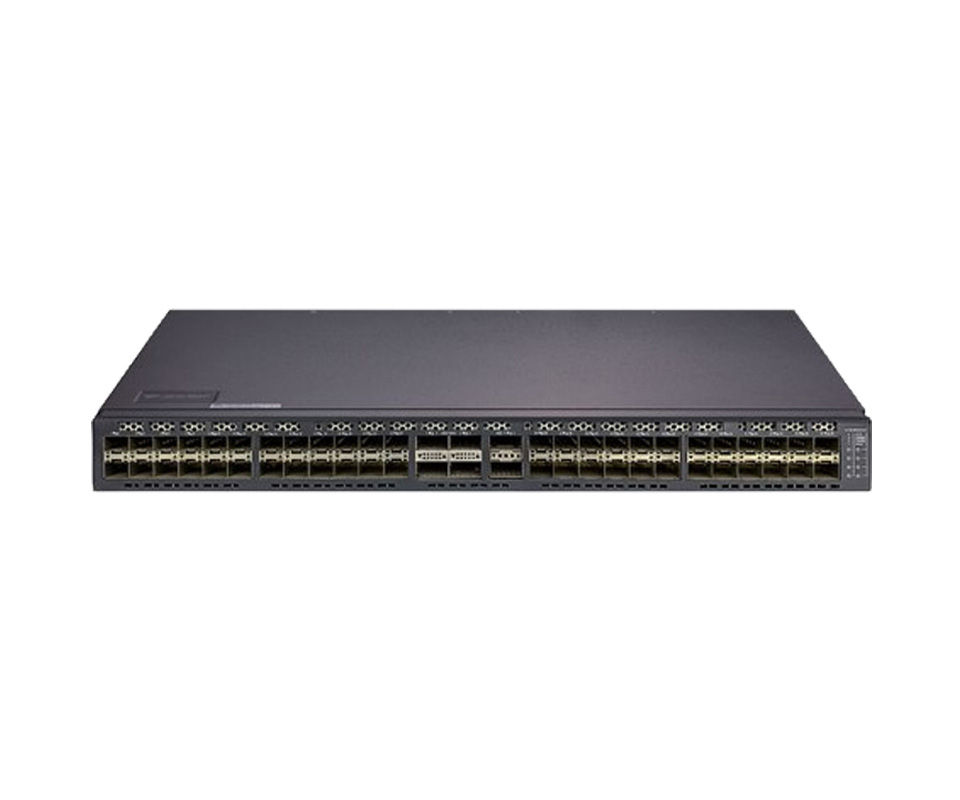
The X54520-B series is a new generation high-performance data center full 10 Gigabit TOR switch launched by Shenzhen Xallcom Technology Co., Ltd. for high-performance cloud computing, data centers, and high-end campus networks. It adopts advanced hardware architecture design, providing the industry's highest switching performance and rich data center business features. The switching capacity is up to 2.56Tbps, supporting 48 10G ports and 4 40G ports.
In order to meet the requirements of cloud computing data center network resource pooling, this switch supports virtualization features as well as data center features such as TRILL, SDN, FCOE/FC, etc. On the basis of providing high-performance L2/L3/L4 line speed switching services, it further integrates various network services such as IPv6, MPLS VPN, network security, traffic analysis, virtualization, etc., combined with various data center high reliability technologies such as uninterrupted upgrading, uninterrupted forwarding, elegant restart, redundancy protection, etc., to ensure the longest uninterrupted communication capability of the network, while integrating industry-leading“ Smart@CHIP ”Intelligent chip green energy-saving technology significantly reduces energy consumption, is low-carbon and environmentally friendly, effectively reduces data center operating costs, and provides a perfect solution for the green and sustainable development of the network.
Product characteristics
Advanced hardware architecture design, industry-leading powerful processing capabilities
Adopting advanced hardware architecture design in the industry, the 1U machine can support 48 10G ports and 4 40G ports
Equipped with high-performance ASIC switching chips and multi-core processors, it supports a switching capacity of up to 1.28Tbps, meeting the requirements of high-performance, high-capacity, high-density, and scalable data centers.
Standard data center front and rear heat dissipation duct design, supporting flexible selection of duct front and rear/rear front.
Rich data center business features
Virtualization cluster switching technology
Support VSS virtualization cluster switching technology, which can virtualize multiple physical devices into a logical device. The performance, reliability, flexibility, and management of its virtual system are unparalleled compared to independent physical devices.
Doubling performance: Virtualization systems can fully utilize every link between physical devices, avoiding the blocking of links by traditional networking model spanning tree protocols, making full use of resources, doubling performance, and maximizing the protection of existing link investments.
High reliability: Based on advanced distributed processing technology and efficient cross physical device link aggregation function, the separation of logical control plane and business data plane is achieved, providing uninterrupted three-layer routing forwarding, avoiding business interruption caused by single point failure, and greatly improving the reliability of virtual systems.
Flexibility: Through the virtual cluster function, the distance of the virtual cluster system can be extended to 80KM, which is flexible and convenient, breaking the geographical limitations of traditional cluster technology.
Easy to manage: The entire virtual system achieves unified management of a single IP address, and the actual physical devices are transparent to users, simplifying the management of network devices and network topology, greatly improving network operation efficiency, and effectively reducing operation and maintenance costs.
Unified Switching: Supports FCoE (FC over Ethernet) technology to solve the problem of heterogeneity between LAN networks and FC storage networks, thereby achieving the integration of computing, data, and storage networks and achieving unified switching.
High reliability at the data center level
Based on the HPS (Hitless Protection System) uninterruptible protection system, the critical power system adopts redundant design, modular and hot swappable, supports seamless switching in case of failure, and does not require business interruption.
Supports STP/RSTP/MSTP protocol, VRRP protocol, as well as simple and efficient redundancy protection mechanisms such as ring network protection, dual uplink primary and backup link protection, LACP link aggregation, etc.
Support ISSU (In Service Software Upgrade) business uninterrupted system upgrade, ensuring uninterrupted forwarding of user data during system upgrade and main control switching.
The ultra-high precision BFD bidirectional link detection mechanism achieves millisecond level fault detection and business recovery through linkage with layer 2 and layer 3 protocols, greatly improving the reliability of the network system.
■ A comprehensive Ethernet OAM mechanism that supports 802.3ah, 802.1ag, and ITU-Y.1731, enabling rapid detection and localization of faults through real-time monitoring of network operation status.
The high reliability design of software and hardware meets the requirement of 50ms fault recovery time, truly achieving high reliability of 5 core devices (99.999%).
Rich business features
Complete second and third layer multicast routing protocols to meet the access requirements of IPTV, multi terminal high-definition video surveillance, and high-definition video conferencing;
Complete three-layer routing protocols, large routing table capacity, meet various types of network interconnection needs, and can form super large data center networks, campus networks, enterprise networks, and industry user private networks.
Full support for second and third layer MPLS VPN, capable of building large MPLS VPN core networks to meet the access needs of industry private network VPN users and enterprise network VPN users.
Comprehensive IPv6 solution
Fully supports the IPv6 protocol family, including IPv6 neighbor discovery, ICMPv6, Path MTU discovery, DHCPv6, and other IPv6 features.
Support IPv6 based Ping, Traceroute, Telnet, SSH, ACL, etc., to meet the needs of pure IPv6 network device management and business control.
Supports IPv6 multicast features such as MLD and MLD Snooping, as well as IPv6 static routing, RIPng, OSPFv3, BGP4+and other IPv6 layer 3 routing protocols, providing users with comprehensive IPv6 layer 2 and 3 solutions.
top of page

You Might Also Like
bottom of page